Community College News

Stay abreast of all the news and reports impacting community colleges. This section covers the latest news stories, from campus protests to Wal-Mart partnerships. Read community college reactions to the latest State of the Union address, identify schools receiving big donations, and analyze the latest laws impacting community colleges and their students.

View the most popular articles in Community College News:

Arizona Community Colleges Defunded: What Students Need to Know

Updated
|
Arizona Community Colleges Defunded: What Students Need to Know
Leading the country in slashing public education spending, Arizona voted to defund higher education, including Pima and Maricopa Community College Districts, leaving many Arizona college students wondering what this new state legislation means for the future of their education.

As much of the country expands funding for community colleges, and with that funding, improved course offerings and increased access to higher education, Arizona has taken the unusual step of taking funding away from some of its community college systems. In fact, according to data just released by the Center on Budget and Policy Priorities, Arizona continues its legacy in 2015 as it did in 2014: leading America in slashes to funding – and in tuition increases.diminish the overall quality of education

Most impacted are two of the state’s largest community college districts – Maricopa County Community College system and Pima Community College. For several years, budget cuts for higher education spending have been the norm. However, what makes these proposed cuts significant is that it removes state funding altogether. Rather than getting a few million dollars, both the Maricopa and Pima community college systems would receive zero dollars in the next fiscincreased by an astounding 80 percental year as part of the state’s new budget. What does this mean for students?

Uproar from Higher Ed

Understandably, higher education officials in Arizona are not pleased with this outcome. Arizona currently ranks first in terms of higher education funding cuts. This is due in part to drastic moves by the state during the Great Recession to remain solvent. However, although the Great Recession has ended, spending is still being cut in Arizona as the state faces a $1.5 billion budget shortfall.
. . .read more

Free Community College Coming Soon? President Obama Hopes So

Updated
|
Free Community College Coming Soon? President Obama Hopes So
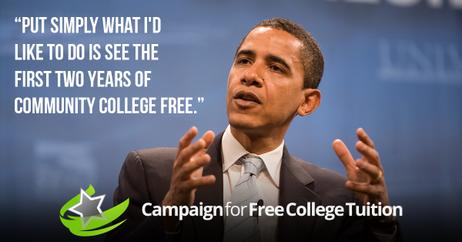
Earlier this year, President Obama outlined a proposal that would make community college free for millions of community college students. What does it mean for you?

So you want to go to college but can’t afford it. Perhaps you don’t want to take out loans that will take decades to pay off. Or maybe you don’t think you’d get many (or any) scholarships or grants because your grades are good enough but not that great or because you make just enough money not to be considered in great financial need.

If the President has his way, none of this will matter.

In January, in his State of the Union Address, President Obama outlined a $60 billion plan to make community college free for everyone. While ‘everyone’ doesn’t actually mean everyone, the plan would still open many doors for students who may not otherwise be able to attend college.

What are the Criteria?

The criteria for a tuition-free community college under the Obama plan are straightforward. Students must maintain a 2.5 GPA, which leads to a smattering of Bs and Cs – grades that most students quickly achieve. Attendance must be at least half-time, which is typically considered to be six or more credit hours each semester. That’s just two classes per semester, which is easily achievable by most students, even those who work or have other obligations outside of school. In short, students who put in the effort would get a free education.

There is, however, a third criterion. To limit the program's long-term costs, the plan would be

. . .read more

Is President Obama's Plan for Free Community College Right for America?

Updated
|
Is President Obama's Plan for Free Community College Right for America?
President Obama recently introduced a plan to deliver free Community College tuition to all Americans across the country. Is it the right call? In this story, we will not attempt to make a judgment call on whether free Community College is right or wrong for the United States. Instead, we paneled a few experts in education and economics to get their take on the issue. We’re showing both sides of the coin, and letting readers decide on their own.

Last week, President Obama introduced a plan to deliver free Community College tuition to all Americans. Is it the right call?

In this story, we will not attempt to make a judgment call on whether free Community College is right or wrong. Instead, we paneled a few experts in education and economics to get their take on the issue. We’re showing both sides of the coin, and letting readers decide on their own.

The Case for Free Community College

The democratization of Higher Education

The most prominent supporters of Obama’s plan laud the proposal as a right step in the right direction toward an equal democracy. One such organization, University of the People, offers tuition-free degrees to many students who would have been shut out of the opportunity to attend college otherwise. Founder and President Shai Reshef says, “According to the proposed plan, students could save an average of $3,800 a year. It is known that the average student spends as much as $1,200 each year on textbooks and supplies alone.”

Rasheen Carbin, Co-founder, and CMO of career app nsphire, says Obama’s plan is the right step for America. “As we all know, the price of college has skyrocketed. We also know, having a Bachelor’s degree adds about a million dollars to your lifetime earnings.” Rasheen is adamant that free community college can lift a burden on lower-income families, and close the gap between poor and wealthy classes in the U.S.

“College is still a

. . .read more

Students Stuck for Four Years to Earn an Associate's Degree

Updated
|
Students Stuck for Four Years to Earn an Associate's Degree
A recent report revealed that many California community college students take twice as long to get an associate’s degree as is normally required. While community college is less expensive than attending a four-year institution, students who drag out their degree programs lose much of that savings in additional tuition, fees, textbooks, and lost wages. In this article, we examine the reasons why some students take so long to graduate.

A new report released by the Campaign for College Opportunity shows that half of the more than 60,000 students who obtained an associate’s degree in California during the 2012-2013 school year took over four years to get their degree. This is an alarmingly long time, especially compared to the 4.7 years it takes the average student to complete a bachelor’s degree at California State University.

Many community college students choose to take that route because of the affordability. According to data from the College Board, in 2011, community college students paid an average of $2,713 in tuition and fees, compared to $7,605 for students who attended an in-state four-year institution. At less than half the cost, community colleges pose significant financial benefits for students on a tight budget.

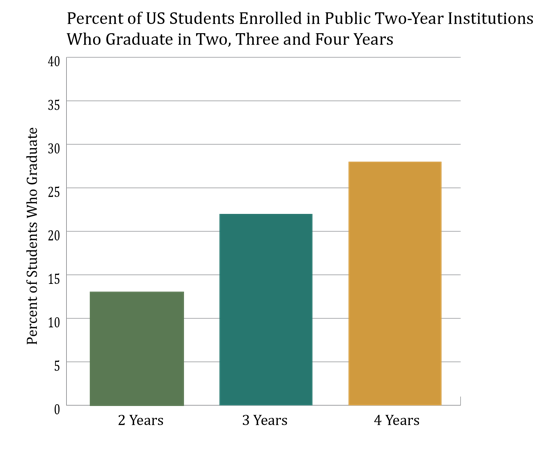
However, time seems to be the biggest enemy of students who begin post-secondary education at the community college level. The College Board’s report shows that of the cohort of students who started their community college studies in 2005, only 21 percent graduated within three years – a full year longer than is traditionally required. Many of the financial benefits gained by attending a two-year institution are lost if students aren’t able to complete their degree on time. Yet, students who enroll in a two-year program are the ones who are most likely to be impacted by factors that extend their graduation timeline. These factors are varied and many.

Insufficient Course Offerings

A

. . .read more

For-Profit Universities Looking to Partner with Community Colleges

Updated
|
For-Profit Universities Looking to Partner with Community Colleges
This article examines the trend of for-profit universities, particularly the University of Phoenix, seeking partnerships with community colleges. It discusses the potential benefits and controversies surrounding these collaborations, focusing on transfer agreements and workforce training programs.

In their quest to find effective transfer agreements for their students, community colleges appear to be tapping an unlikely source – for-profit schools. The University of Phoenix has announced partnerships pending with several community colleges nationwide to offer students at these schools seamless four-year degree options. However, not everyone believes the union between for-profit schools and community colleges will be amicable or beneficial.

100 New Partnerships Announced by For-Profit

The American Independent reports that the University of Phoenix will launch over 100 partnerships with various community colleges nationwide this upcoming school year. The for-profit university hopes the new arrangements will provide the financial shot in the arm the institution needs after suffering significant budget setbacks in recent years. Reputation is also a concern for the University of Phoenix, as the for-profit sector has been plagued with reports of low completion rates and high student debt.

Despite promises of dozens of partnerships by the end of 2013, the University of Phoenix has only finalized agreements with a handful of community colleges thus far. The most notable is a transfer agreement with Northern Virginia Community College, known as NOVA. NOVA has received plenty of attention from the recent administration since this is the school where Dr. Jill Biden, wife of Vice President Joe Biden, teaches.

The second system partnered with the University of Phoenix is the Maricopa Community College System in Arizona. According to a press release at Bloomberg, the community college system will

. . .read more

Recent Articles

As Four-Year Colleges Enter Short-Term Training, Should You Still Choose a Community College?
As universities expand short-term workforce certificates, learn how community colleges compare on cost, flexibility, employer partnerships, and career outcomes.
What New Federal Aid Rules Mean for Short-Term Training Choices
Learn how new federal financial aid rules affect short-term workforce training programs and what prospective community college students should consider before enrolling.
Childcare, Transportation, and Food Support: Services That Drive Community College Completion
Learn how childcare, transportation, food assistance, and other basic needs services help community college students stay enrolled and graduate.