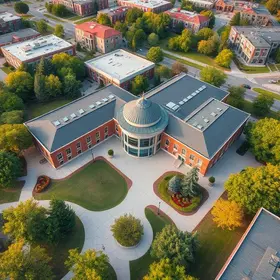
School Highlights
The Salon Professional Academy-Fargo serves 95 students (94% of students are full-time).
The college's student-teacher ratio of 9:1 is lower than the state community college average of 20:1.
Minority enrollment is 22% of the student body (majority Black and Hispanic), which is less than the state average of 28%.
Quick Facts (2026)
- Enrollment: 95 students
- Student-teacher ratio: 9:1
- Minority enrollment: 22%
- Source: Integrated Postsecondary Education Data System (IPEDS)
School Overview
The teacher population of 11 teachers has stayed relatively flat over five years.
The Salon Professional Academy-Fargo
(ND) Community College Avg.
Carnegie Classification
Not applicable, not in Carnegie universe (not accredited or nondegree-granting)
Associate's Colleges: High Career & Technical-High Nontraditional
Institution Level
Less than 2 years (below associate)
Four or more years
Institution Control
Private for-profit
Public
Colors
Not mentioned
Total Faculty
11 staff
14 staff
Number of Programs Offered
4
4
School Calendar
Student Body
The student population of The Salon Professional Academy-Fargo has declined by 44% over five years.
The student-teacher ratio of 9:1 has stayed the same over five years.
The The Salon Professional Academy-Fargo diversity score of 0.38 is more than the state average of 0.00. The school's diversity has grown by 8% over five years.
Total Enrollment
95 students
859 students
Student-Teacher Ratio
9:1
20:1
# Full-Time Students
89 students
127 students
# Part-Time Students
6 students
732 students
# Enrollment Undergraduate
217 students
307 students
# Full-Time Undergraduate Students
89 students
127 students
# Part-Time Undergraduate Students
6 students
732 students
% American Indian/Alaskan
5%
3%
% Asian
1%
1%
% Hispanic
6%
5%
% Black
6%
4%
% White
78%
72%
% Two or more races
3%
4%
Diversity Score
0.38
0.00
College Completion Rate (Students who graduate in less than 4 years)
78%
59%
Tuition and Acceptance Rate
% Students Receiving Some Financial Aid
43%
91%
Median Debt for Graduates
$12,000
$9,600
Median Debt for Dropouts
$4,750
$5,500
Source: 2025 (or latest year available) Integrated Postsecondary Education Data System (IPEDS)
Nearby Schools
The nearest community college to The Salon Professional Academy-Fargo is Rasmussen University-North Dakota (0.8 miles away)
School
Location
Miles
Quick Facts
Rasmussen University-North Dakota
Private for-profit
4012 19th Avenue SW
Fargo, ND 58103
(701) 277-3889
Fargo, ND 58103
(701) 277-3889
0.8 miles
Enrollment: 52 students Student-teacher ratio: 5:1 Private-state tuition: $10,764 Minority enrollment: 52%
Josef's School of Hair, Skin & Body-Fargo
Private for-profit
3223 13 AVE S, Ste A
Fargo, ND 58103
(701) 235-9910
Fargo, ND 58103
(701) 235-9910
1.3 miles
Enrollment: 72 students Student-teacher ratio: 18:1 Minority enrollment: 34%
800 N 6th St
Wahpeton, ND 58076
(701) 671-2403
Wahpeton, ND 58076
(701) 671-2403
42.3 miles
Enrollment: 3,367 students Student-teacher ratio: 20:1 Acceptance rate: 95% In-state tuition: $4,438 Out-state tuition: $10,850 Minority enrollment: 26%

900 hwy 34 e
Detroit Lakes, MN 56501
(218) 846-7444
Detroit Lakes, MN 56501
(218) 846-7444
48.5 miles
Acceptance rate: 98%
White Earth Tribal and Community College
Private not-for-profit
2250 College Road
Mahnomen, MN 56557
(218) 935-0417
Mahnomen, MN 56557
(218) 935-0417
53.2 miles
Enrollment: 119 students Student-teacher ratio: 17:1 Minority enrollment: 89%
Recent Articles

As Four-Year Colleges Enter Short-Term Training, Should You Still Choose a Community College?
As universities expand short-term workforce certificates, learn how community colleges compare on cost, flexibility, employer partnerships, and career outcomes.

What New Federal Aid Rules Mean for Short-Term Training Choices
Learn how new federal financial aid rules affect short-term workforce training programs and what prospective community college students should consider before enrolling.

Childcare, Transportation, and Food Support: Services That Drive Community College Completion
Learn how childcare, transportation, food assistance, and other basic needs services help community college students stay enrolled and graduate.