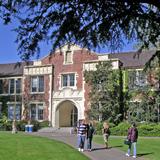
Mendocino College serves the educational needs of our students and our community by providing academic programs, transfer preparation, vocational training, lifelong learning opportunities and student support.
School Highlights
Mendocino College serves 4,225 students (22% of students are full-time).
The college's student-teacher ratio of 30:1 is lower than the state community college average of 44:1.
Minority enrollment is 62% of the student body (majority Hispanic), which is less than the state average of 77%.
Quick Facts (2026)
Enrollment: 4,225 students
In-state tuition: $1,422
Out-state tuition: $5,892
Acceptance Rate: 75%
Student-teacher ratio: 30:1
Minority enrollment: 62%
Source: Integrated Postsecondary Education Data System (IPEDS)
School Overview
The teacher population of 140 teachers has declined by 42% over five years.
Mendocino College
(CA) Community College Avg.
Carnegie Classification
Associate's Colleges
Associate's Colleges: High Transfer-High Traditional
Note: Data may not be displayed on any public-facing website or service that replicates or resembles a college search or review portal without prior written permission. See our Terms of Service.
Note: Data may not be displayed on any public-facing website or service that replicates or resembles a college search or review portal without prior written permission. See our Terms of Service.
Note: Data may not be displayed on any public-facing website or service that replicates or resembles a college search or review portal without prior written permission. See our Terms of Service.
Note: Data may not be displayed on any public-facing website or service that replicates or resembles a college search or review portal without prior written permission. See our Terms of Service.
Note: Data may not be displayed on any public-facing website or service that replicates or resembles a college search or review portal without prior written permission. See our Terms of Service.
Note: Data may not be displayed on any public-facing website or service that replicates or resembles a college search or review portal without prior written permission. See our Terms of Service.
Note: Data may not be displayed on any public-facing website or service that replicates or resembles a college search or review portal without prior written permission. See our Terms of Service.
Note: Data may not be displayed on any public-facing website or service that replicates or resembles a college search or review portal without prior written permission. See our Terms of Service.
Note: Data may not be displayed on any public-facing website or service that replicates or resembles a college search or review portal without prior written permission. See our Terms of Service.
Note: Data may not be displayed on any public-facing website or service that replicates or resembles a college search or review portal without prior written permission. See our Terms of Service.
Note: Data may not be displayed on any public-facing website or service that replicates or resembles a college search or review portal without prior written permission. See our Terms of Service.
Note: Data may not be displayed on any public-facing website or service that replicates or resembles a college search or review portal without prior written permission. See our Terms of Service.
Note: Data may not be displayed on any public-facing website or service that replicates or resembles a college search or review portal without prior written permission. See our Terms of Service.
College Completion Rate (Students who graduate in less than 4 years)
Note: Data may not be displayed on any public-facing website or service that replicates or resembles a college search or review portal without prior written permission. See our Terms of Service.
Note: Data may not be displayed on any public-facing website or service that replicates or resembles a college search or review portal without prior written permission. See our Terms of Service.
Tuition and Acceptance Rate
The public in-state tuition of $1,422 is more than the state average of $1,236. The in-state tuition has stayed relatively flat over four years.
The public out-state tuition of $5,892 is less than the state average of $6,577. The out-state tuition has declined by 30% over four years.
Note: Data may not be displayed on any public-facing website or service that replicates or resembles a college search or review portal without prior written permission. See our Terms of Service.
Note: Data may not be displayed on any public-facing website or service that replicates or resembles a college search or review portal without prior written permission. See our Terms of Service.
Note: Data may not be displayed on any public-facing website or service that replicates or resembles a college search or review portal without prior written permission. See our Terms of Service.
Note: Data may not be displayed on any public-facing website or service that replicates or resembles a college search or review portal without prior written permission. See our Terms of Service.
Note: Data may not be displayed on any public-facing website or service that replicates or resembles a college search or review portal without prior written permission. See our Terms of Service.
Note: Data may not be displayed on any public-facing website or service that replicates or resembles a college search or review portal without prior written permission. See our Terms of Service.
Source: 2025 (or latest year available) Integrated Postsecondary Education Data System (IPEDS) , School Administrators
School Notes
The Mendocino-Lake Community College District was formed in
September 1972 by vote of the citizens of the Anderson Valley,
Laytonville, Potter Valley, Round Valley, Ukiah, and Willits
Unified School Districts. Planning for the development of the
initial offerings of the College occurred in the Spring of 1973,
with the first classes offered in July 1973. our new Ukiah Campus
has 20,000 sq. ft. Science Complex. This new facility, along with
our state-of-the-art Center for Visual and Performing Arts,
Athletic Complex, Lowery Library building, and Vocational Education
facility, offer students excellent resources to pursue their goals.
Mendocino College is accredited by accrediting Commission for
Community and Junior Colleges of the Western Association of Schools
and Colleges.
As universities expand short-term workforce certificates, learn how community colleges compare on cost, flexibility, employer partnerships, and career outcomes.
Learn how new federal financial aid rules affect short-term workforce training programs and what prospective community college students should consider before enrolling.