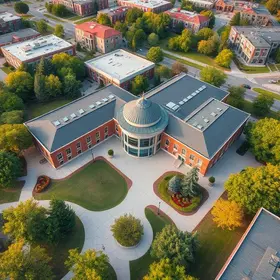
- Heald College prepares students for academic, personal, and professional success through quality career-focused programs that develop skills to last a lifetime.
School Highlights
Heald College-Concord served 1,232 students (83% of students were full-time).
The college's student-teacher ratio of 27:1 was lower than the state community college average of 44:1.
Minority enrollment was 82% of the student body (majority Hispanic and Black), which was more than the state average of 77%.
School Overview
Heald College-Concord
(CA) Community College Avg.
Carnegie Classification
Associates Colleges
Associate's Colleges: High Transfer-High Traditional
Institution Level
At least 2 but less than 4 years
At least 2 but less than 4 years
Institution Control
Private, for profit
Public
Total Faculty
46 staff
72 staff
Student Body
Total Enrollment
1,232 students
6,838 students
Student-Teacher Ratio
27:1
44:1
# Full-Time Students
1,020 students
1,022 students
# Part-Time Students
212 students
5,816 students
# Enrollment Undergraduate
161 students
390 students
# Full-Time Undergraduate Students
1,020 students
967 students
# Part-Time Undergraduate Students
212 students
5,798 students
% Asian
9%
12%
% Hispanic
22%
46%
% Black
15%
7%
% White
18%
23%
% Hawaiian
2%
n/a
% Two or more races
4%
5%
% Unknown races
29%
6%
Diversity Score
0.80
0.00
College Completion Rate (Students who graduate in less than 4 years)
35%
28%
Average Graduate Earnings (10 Years)
$41,900
$32,200
Tuition and Acceptance Rate
Private State Tuition Fees
$13,620
$18,639
% Students Receiving Some Financial Aid
91%
85%
Median Debt for Graduates
$11,676
$9,500
Median Debt for Dropouts
$8,826
$5,500
Acceptance Rate
88%
100%
Source: 2015 (or latest year available) Integrated Postsecondary Education Data System (IPEDS)
School Notes
- Heald is regionally accredited private career college that has been preparing students for rewarding careers in Business, Technology and Healthcare for over 140 years. We started with one campus in San Francisco, back in 1863, and we've expanded to 11 campuses across the western United States: Concord, Fresno, Hayward, Rancho Cordova, Roseville, Salinas, San Francisco, San Jose, Stockton, Honolulu and Portland. For more than 140 years, Heald College has been committed to preparing students for academic, personal, and professional success through quality career-focused programs that develop skills to last a lifetime. Because Heald College is a nonprofit educational institution, it invests in its students by providing small classes and fostering a supportive environment for learning. Over the last several years, Heald Concord has expanded to better meet the growing demand for qualified business, technology, medical and dental degree graduates in the area. Established in 1975, Heald Concord has a strong presence in the community and an outstanding reputation with local employers. Located in a 66,000-square-foot, fully networked facility, Heald College Concord serves all of Contra Costa County. The building features a beautiful, multi-purpose conference center with complete wireless capability. The campus has expanded three times over the last several years to better meet the growing local demand for qualified business, technology and healthcare degree graduates. Recently it began offering a dental assisting program and added a state-of-the-art dental lab. All Heald campuses are regionally accredited through the Accrediting Commission for Community and Junior Colleges (ACCJC) of the Western Association of Schools and Colleges (WASC). That means we're recognized by the U.S. Department of Education for meeting high standards for providing excellence in education.
Frequently Asked Questions
How much does Heald College-Concord cost?
Heald College-Concord's private state tuition is approximately $13,620.
What is the acceptance rate of Heald College-Concord?
The acceptance rate of Heald College-Concord is 88%, which is lower than the state average of 100%.
Recent Articles

As Four-Year Colleges Enter Short-Term Training, Should You Still Choose a Community College?
As universities expand short-term workforce certificates, learn how community colleges compare on cost, flexibility, employer partnerships, and career outcomes.

What New Federal Aid Rules Mean for Short-Term Training Choices
Learn how new federal financial aid rules affect short-term workforce training programs and what prospective community college students should consider before enrolling.

Childcare, Transportation, and Food Support: Services That Drive Community College Completion
Learn how childcare, transportation, food assistance, and other basic needs services help community college students stay enrolled and graduate.