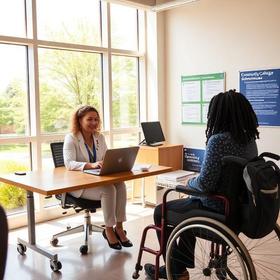
Improving Your Job Search

Whether you have just enrolled in community college or you’re ready to graduate and enter the job market, our articles can help improve your opportunities of landing the perfect job. Internships and apprenticeships offer lots of benefits, find out how participation in these programs can move your resume to the top of the pile. Analyze employment data for community college graduates and determine who is getting hired. Get valuable tips on polishing your candidacy and making the most of job fairs.

View the most popular articles in Improving Your Job Search:

The Working Student Schedule Test: Can You Balance College and a Job?

Updated
|
The Working Student Schedule Test: Can You Balance College and a Job?
Discover how to evaluate whether your work schedule is compatible with community college before classes begin, and learn practical strategies that help working students stay on track toward graduation.

For many students, working while attending community college is not a choice; it is a necessity. Whether you're helping pay tuition, supporting your family, or covering everyday expenses, employment is often an essential part of earning a degree. The challenge is finding a balance that allows you to succeed both at work and in the classroom.

Many students assume they can simply fit college around their work schedule. Unfortunately, that's not always realistic. Long shifts, unpredictable hours, and limited study time can gradually lead to missed assignments, declining grades, and eventually stopping out before completing a certificate or degree.

Before registering for classes, it helps to put your weekly routine through a simple test. Rather than asking whether you can squeeze classes into your schedule, ask whether your schedule actually supports learning, studying, and maintaining your health throughout the semester.

Step 1: Count Every Hour, Not Just Your Class Time

One of the biggest mistakes new college students make is underestimating how much time coursework requires outside the classroom.

A typical three-credit course usually requires several additional hours each week for reading, assignments, studying, projects, and exam preparation. A full-time student taking four or five classes may easily spend 35 to 45 hours each week on academics alone.

Now compare that commitment with your work schedule.

If you're working 35 to 40 hours per week while attending school full time, you're essentially taking on two full-time responsibilities. That may be manageable for a short period, but it can

. . .read more

Understanding the Different Types of College Degrees and How to Choose

Updated
|
Understanding the Different Types of College Degrees and How to Choose
Choosing a college major can be tough, but you also need to think about choosing the right type of degree. Keep reading to learn about the five different types of college degrees and your earning potential for each one.

Understanding the Different Types of College Degrees and How to Choose

The world of higher education is vast and has many different options.

  • Whether you choose to attend community college or a traditional college or university, there are a number of other degrees to choose from, and each one offers unique potential in terms of your future career.
  • Before you apply to college, you should consider your field as well as the type of degree you intend to pursue.
  • Not every job requires a college degree, but many do.
  • There are also many careers where you are unlikely to succeed without an advanced degree.

The Five Types of College Degrees

One of the main benefits of earning a college degree is that it increases your earning potential.

  • College graduates earn more than non-degree holders in most fields.
  • Outside of higher income potential, the process of earning your degree opens you up to a whole new world of learning, and you develop skills you may not have had before.
  • Having a degree typically means better job security, more career options, and more personal development along the way.

There are many benefits to having a degree, but not all degrees are created equal. Here is an overview of the five different types of college degrees:

  1. Associate Degree (ex: Associate of Arts or Associate of Science)
  2. Bachelor’s Degree (ex: Bachelor of Arts or Bachelor of Science)
  3. Master’s Degree (ex: Master of Arts, Master
. . .read more

Tips for Community College Grads to Break the Millenial Stereotype

Updated
|
Tips for Community College Grads to Break the Millenial Stereotype
The millennial generation is assumed to be entitled, lazy, and tech-obsessed. When you graduate from college, you may find yourself working against these stereotypes to land your first job. Keep reading to learn some tips for breaking those millennial stereotypes.

There was a time when obtaining a college degree almost guaranteed you a job after graduation. Unfortunately, that no longer seems to be the case. Hundreds of thousands of college graduates enter the “real world” each year and many of them struggle to find a job in their field, no less a job at all.

Many college graduates find that entry-level positions require work experience – experience which they can’t get if no one will give them a job. Add to that the challenge of being labeled a “millennial,” and finding steady employment after graduation is like finding a diamond in the rough.

So, how do you break through the millennial stereotype to land your first job? Keep reading to learn what the top millennial stereotypes are and how to overcome them to get a job.

This TEDx Talk by Keevin O'Rourke discusses How to Make Millennials Want to Work for You.

What Are the Most Common Stereotypes About Millenials?

First and foremost, it needs to be established exactly what a millennial is. There is some confusion regarding which ages fall into the millennial category, but most researchers agree that millennials are the generation born between 1980 and 1996. People born during this generation have been assigned all kinds of labels including lazy and entitled. The more these labels are used, the more they perpetuate the stereotype – a stereotype that may or may

. . .read more

Getting into Law School with a Community College Degree

Updated
|
Getting into Law School with a Community College Degree
You don't have to be a pre-law major to get into law school, but how will your application be impacted by your community college degree?

Community college appeals to people from all walks of life for several reasons. For some, community college offers a degree of flexibility that can’t be had at some colleges and universities, and for others, it is a way to save money on tuition. But will graduating from a community college instead of a traditional college or university hurt your chances of success in pursuing a career in certain fields? Keep reading to learn valuable tips for applying to law school with a community college degree.

When Should You Apply to Law School?

Many students successfully admitted into law school agree that applying early is always best. Many law schools accept applications on a rolling basis, releasing their decisions over the course of several months. While applying early will not guarantee your admission, applying closer to the deadline means fewer spaces may be left to fill, which could hurt your chances of getting in. Remember that most schools will not even begin to review your application until they have received all the necessary documents to be proactive about making your requests for recommendations and writing your essays. Take the LSAT as soon as possible without compromising your score – if you are fully prepared, take the test at the first available sitting. You should also remember that even if you are not accepted during the first round of admissions, there may still be hope. Many schools put students on a waitlist, offering priority acceptance to one set of students

. . .read more

Do You Need to Pick a Major Before Starting Community College?

Updated
|
Do You Need to Pick a Major Before Starting Community College?
Picking a major is a big decision. You shouldn't rush, but there are benefits to making your choice early. Keep reading to receive tips for choosing a major.

When you set foot on a college campus for the first time and start to meet other students, the question you are most likely to be asked first is, “What’s your major?” For some, this question rears its ugly head even earlier, during high school before you even decide where (or if) you are going to college. Choosing a major is a big decision and one that will have a serious impact on the rest of your life. This being the case, it is not something you should take lightly.

But just how important is it to pick a major before you start college? Or can you wait until you have a few classes under your belt to see what you really like? If you are still undecided, it isn’t the end of the world – you can still graduate with the major of your choice and enter the “real world” in your chosen field. Keep reading to learn more about which majors offer the best chances for success and to receive tips for choosing a major that suits your interests.

What Exactly is a Major?

A college major is simply a specialized area of study. When you choose a major, you are choosing the direction of your academic career. In addition to taking any general education requirements your school might have, you will also be taking classes that are relevant to your major. Most community colleges and traditional universities offer a wide variety of

. . .read more

Recent Articles

As Four-Year Colleges Enter Short-Term Training, Should You Still Choose a Community College?
As universities expand short-term workforce certificates, learn how community colleges compare on cost, flexibility, employer partnerships, and career outcomes.
What New Federal Aid Rules Mean for Short-Term Training Choices
Learn how new federal financial aid rules affect short-term workforce training programs and what prospective community college students should consider before enrolling.
Childcare, Transportation, and Food Support: Services That Drive Community College Completion
Learn how childcare, transportation, food assistance, and other basic needs services help community college students stay enrolled and graduate.