Job Searching

Community Colleges: Get a Job or Get Your Money Back

Updated
|
Community Colleges: Get a Job or Get Your Money Back
Learn how Lansing Community College's job guarantee program helped shape workforce education and how career-focused community college programs continue to evolve in 2026.

In the consumer world, "satisfaction guaranteed or your money back" is a common promise. However, this guarantee has rarely crossed into the academic realm. Michigan's Lansing Community College made headlines by offering a guarantee that was virtually unprecedented in higher education: get a job or your money back.

Although the program discussed in this article was introduced more than a decade ago, it remains an interesting example of how community colleges have long looked for innovative ways to prepare students for the workforce. Today, many community colleges partner directly with local employers, offer short-term workforce credentials, and provide extensive career placement services designed to connect graduates with in-demand careers.

Program Seeks to Encourage Prospective Students

According to Lansing Community College president Brent Knight, the guarantee was meant to alleviate the apprehension some people felt about returning to school during a difficult economy. Prospective students wondered whether investing time and money in a new degree or further job training was worthwhile if those efforts would not translate into better employment opportunities after graduation.

Knight acknowledged, "Many people are discouraged in job seeking. Why spend money, take time to learn when you may not get a job?"

The new program, called "Get a Skill, Get a Job or Your Money Back," aimed to ease those concerns. It promised students who enrolled in certain occupational training programs that if they were unable to find employment in their field within one year of graduation, Lansing Community College would refund

. . .read more

The Secrets to Success at Community College Job Fairs

Updated
|
The Secrets to Success at Community College Job Fairs
Capitalize upon the secrets and strategies of enhancing your job prospects and career opportunities at a community college job fair.

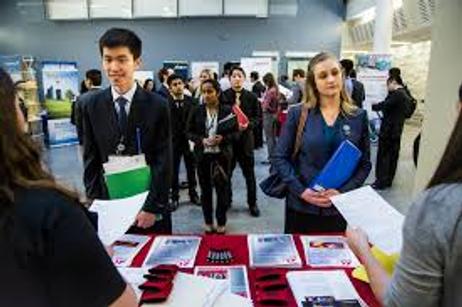
Job and career fairs offer students various convenient, useful, and potentially lucrative opportunities. Considering that many community college students preparing for upcoming graduation are uncertain about how to apply for jobs, establish networks, and even get a single proverbial foot in the door, job fairs provide an excellent alternative to the traditional search.

Instead of the traditional approach, which mandates that students independently seek out jobs and send in resumes, a community college job fair brings employers to the students. Job fairs are large congregations of employers seeking new college graduates to become part of their staff. Typically, job fairs allow students to meet leaders in their career field while allowing students to submit their resumes to multiple employers at one big event. Some students attending job fairs are even hired for jobs on the spot!

Community College Job Fair Tips

Every community college provides its students with annual, biannual, or even monthly job fair events. As Lenoir Community College, located in Kingston, North Carolina, asserts, these job fair events are intended to help all students. “Anyone can use a job fair to make contacts, distribute resumes, and explore new avenues of employment.” To take advantage of the many benefits of job fair, prepare yourself with the key tips for success.

Prepare and Edit Your Resume

Before attending your job fair, ensure your resume is easy to read and completely error-free. As your resume is the only source of information by which employers can often

. . .read more

Recession-Proof Careers for Community College Students

Updated
|
Recession-Proof Careers for Community College Students
Learn about several careers for community college students that are likely to weather an economic downturn.

While many recent graduates may struggle to find sustainable work amidst a declining economy, community college students are discovering new “recession-proof” career paths that are both reliable and lucrative, despite economic hardships.

As Emily Gersema of The Arizona Republic argues, community colleges are becoming increasingly aware of job market demands since “employers come to them to set up programs tailored to their staffing needs.” Careers in various industries are proving to be strong and sustainable options for community college students after graduation.

Health Care Careers

According to research supported by Kiplinger, a renounced financial and economic forecasting company, healthcare is one the top options for students looking for a sustainable educational path or for recent graduates seeking employment: “Many of the nation's fastest-growing careers are in the healthcare industry, according to the Bureau of Labor Statistics.”

As the population age continues to rise, careers in health care should remain reliable and strong, as the demand is projected for years to come. Specific healthcare jobs for community college students include careers in the field of nursing, physical therapy, nursing home aid, physician assistant, and many more.

And in specifically analyzing the rising demands, Gersema further explains, “Healthcare needs…continue to rise. Clinics and dental offices are tapping programs such as the dental-hygienist program at Mesa Community College for workers.” Paired with this, jobs are also on the rise for individuals who are fluent in global languages[C1], particularly Spanish. “Demand is increasing for healthcare workers who speak Spanish

. . .read more

High Paying Careers Without Four Year Degrees

Updated
|
High Paying Careers Without Four Year Degrees
Learn how community colleges and associate degrees can lead to high paying careers.

As the costs of all school programs are rising, community colleges are offering more affordable education plans that prepare young professionals for some of the top paying careers. As CNN comments on the top paying jobs, “though a college degree is not a requirement for these positions, all require moderate to extensive on-the-job training or apprenticeship. In addition, dental hygienists, radiation therapists, nuclear medicine technologists, and commercial pilots require an associate degree at a vocational or technical school.”

Ultimately, as some of the top-paying careers only require a two- year degree, certification, or select courses, community colleges are offering financially affordable and rewarding pathways for future success.

Moving Towards a New Career Frontier

The correspondence between higher education and higher income is now becoming history; according to CNN, “Though it was once conventional wisdom that you needed to have a four-year college degree to be successful, many employment experts believe that maxim has become myth. While a college education increases a worker's chances of earning more money, it's certainly not the only reliable path to well-paid and rewarding work.”

While most lucrative jobs require post-high school training, most of the top-paying careers do not require a four-year degree – and thus, community colleges really stand out against 4 year universities. In fact, “there are […] (approximately) 50 million jobs out there that don't require a bachelor's degree and pay upwards of $40,000 a year.”

According to the United States Bureau of Labor and Statistics, eight of

. . .read more

Careers After Community College

Updated
|
Careers After Community College
Learn about fast-growing careers and degrees community college grads are pursuing.

Many students who are considering attending community college want to know what their career opportunities are after graduating. If you are contemplating community college, then you are in for good news!

The professional prospects for a community college grad are very promising. According to the American Association of Community Colleges (AACC), who analyzed data presented by the US Department of Education and College Board, the average community college graduate earns significant more than a high school graduate. When it comes to the average expected lifetime earnings, those with an associate’s degree earn $1.6 million, which is significant more than the $.4 million a high school graduate will earn. From this perspective alone, graduating from community college will earn your bank account an extra $1.2 million in your lifetime!

Popular community college majors

Although the majors and careers found in community college are quite diverse, ranging from art to zoology, there are several majors that are highly popular, according to the AACC. The five most popular majors in community college are:

  • Computer technologies – 1,017 programs throughout community colleges
  • Registered nursing – 755 programs offered in community colleges
  • Law enforcement – 751 programs offered nationally through community colleges
  • Licensed practical nursing – 528 programs throughout community colleges
  • Radiology – 269 programs offered through community colleges

The working applications of community college

The AACC estimates that there are 11 million students enrolled in community college; with the sheer numbers of the community college student population, employers have taken note of the high caliber of

. . .read more

Recent Articles

As Four-Year Colleges Enter Short-Term Training, Should You Still Choose a Community College?
As universities expand short-term workforce certificates, learn how community colleges compare on cost, flexibility, employer partnerships, and career outcomes.
What New Federal Aid Rules Mean for Short-Term Training Choices
Learn how new federal financial aid rules affect short-term workforce training programs and what prospective community college students should consider before enrolling.
Childcare, Transportation, and Food Support: Services That Drive Community College Completion
Learn how childcare, transportation, food assistance, and other basic needs services help community college students stay enrolled and graduate.

Job Searching