College Policies

Community college polices are frequently being updated. Keep current on the latest bans, free speech initiatives and safety protocols. Learn what schools are doing to increase funding in the midst of widespread budget cuts, determine the best practices to ensure safety on campus and get the latest on school controversies and student rights.

View the most popular articles in College Policies:

Smoke-Free Community Colleges: Policies and Trends 2026

Updated
|
Smoke-Free Community Colleges: Policies and Trends 2026
Explore smoke-free community college policies in 2026, including vaping bans, health impacts, and campus-wide tobacco-free initiatives.

This article has been updated to reflect 2026 data and recent developments.

Smoke-free policies at community colleges have evolved significantly over the past decade. What began as designated smoking areas has, in many cases, transitioned into fully tobacco-free campuses. In 2026, community colleges will not only ban traditional cigarettes but also address vaping, e-cigarettes, and emerging nicotine products.

This shift reflects broader public health priorities, changing student attitudes, and updated federal and state guidance. As community colleges continue to serve diverse student populations, their approach to campus health policies offers insight into larger trends in higher education.

The Shift Toward Tobacco-Free Campuses

Community colleges were early adopters of smoke-free policies, but the definition of “smoke-free” has expanded.

Today, many institutions enforce tobacco-free campus policies, which prohibit:

  • Cigarettes
  • Cigars and smokeless tobacco
  • E-cigarettes and vaping devices
  • Heated tobacco products

According to the American Nonsmokers’ Rights Foundation, thousands of U.S. colleges and universities now maintain 100 percent smoke-free or tobacco-free policies.

This shift aligns with updated public health recommendations and reflects growing awareness of secondhand smoke and aerosol exposure risks.

Why Community Colleges Are Leading the Movement

Community colleges are uniquely positioned to implement and scale these policies.

Diverse Student Populations

Community colleges serve students across age groups, socioeconomic backgrounds, and life stages. Many institutions emphasize accessible, healthy environments that support both traditional and adult learners.

Public Health Alignment

Most community colleges operate within public systems, making them more responsive to state and federal health initiatives. Policies often align with guidance from the Centers for Disease Control and Prevention.

Campus-Wide Impact

Unlike residential universities, community colleges

. . .read more

Sending Prisoners Back to School? A New IHEP Study Says Yes

Updated
|
Sending Prisoners Back to School? A New IHEP Study Says Yes
A new study from the Institute of Higher Education Policy recommends prisoners to attend community college courses via distance learning. Learn about the surprising study and its potential benefits for incarcerated individuals and general society.

Incarcerated individuals are much more likely to return to prison three years after their release if they do not have access to educational opportunities beyond high school, a new study from the Institute of Higher Education Policy has found. In the report titled "Unlocking Potential: Results of a National Survey of Postsecondary Education in State Prisons," IHEP has determined that providing prisoners with access to college education benefits both the individual and society at large. The report was published this month on the IHEP website, including recommendations for policymakers regarding prisoners currently in the system.

According to IHEP, there are approximately 2.3 million people in the prison system in the United States today, costing taxpayers about $52 billion each year. Without access to any postsecondary education, seven of 10 formerly incarcerated individuals will return to prison within three years of their initial release. Recidivism costs states every year, which is why policymakers must consider instituting programs within the prison system to provide prisoners with the necessary training and education to find jobs after their release.

The Profile of a Prisoner

The IHEP study found many common characteristics of incarcerated individuals vs. the general population today, including:

  • Incarcerated individuals are much more likely to come from economically disadvantaged backgrounds than the general population
  • Those in prison tend to be from racial and ethnic minorities to a higher degree than the population at large
  • Many in prison today were either working at low-paying jobs or not
. . .read more

Hands Across California: Community College Students Band Together to Save the System

Updated
|
Hands Across California: Community College Students Band Together to Save the System
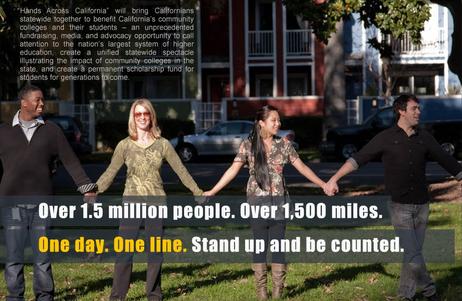
Facing a monumental budget crisis, California's community college students took matters into their own hands, holding rallies and conferences for Hands Across California.

California is amidst a genuine budget crisis, and higher education students are feeling the pinch just as much – if not more – than the rest of the state. According to a recent report at Mercury News, Governor Jerry Brown's proposed budget cuts would trim another $400 million from community colleges and raise student fees by 40 percent. Some predict that the reduction would result in about 400,000 community college students being unable to get the necessary courses to complete their degree programs. While lawmakers continue to debate the proposed budget and its effect on California residents, college students are taking matters into their own hands.

What is Hands Across California?

Hands Across California is the latest organized effort by Ken Kragen, known for his work with Hands Across America, NetAid, and We Are the World fundraisers. Kragen entered the picture to help community college advocates raise awareness of the financial needs of students across the state. According to the Huffington Post, this movement, which took place on April 17, served two purposes: to raise awareness of today's college students' critical needs and to raise funding to support needy students through additional scholarships.

Money raised through Hands across California will go directly to support the California Community Colleges Scholarship Endowment. The Bernard Osher Foundation, well known for its support of the California community college system, has pledged a 50 percent match to all funds collected.

On April 17, 2011, community college students, employees,

. . .read more

Culinary Arts, Athletics, Massage Therapy and More: Programs Cut at Community Colleges

Updated
|
Culinary Arts, Athletics, Massage Therapy and More: Programs Cut at Community Colleges
Against massive budget cuts, community colleges have been forced to take drastic measures, including cutting entire programs ranging from the culinary arts to athletics.

When budgets are slashed, spending is cut along the falling numbers, which is precisely what many community colleges face during today's economic crunch. Unfortunately, programs are often the victims of penny-pinching, with colleges slashing programs in everything from culinary arts to massage therapy. We will take a look at a few of the community colleges across the country that are facing big challenges in balancing their budgets – and who the real losers will be in the long run.

Cutting Programs at St. Charles

St. Charles Community College in Missouri is just one of the schools in this state that is scrutinizing programs to determine which ones can be cut without hurting student opportunities in popular fields. According to a recent Suburban Journals report, SCC plans to delete five associate degree programs from their course catalog next year: massage therapy, environmental science, electronics engineering technology, industrial maintenance technology, and medical transcription. The programs were listed in a review of public and community college academic programs released by Missouri Governor Jay Nixon.

College officials have stated that the programs slated for the ax have low enrollment numbers, and none have any students currently going through the programs. Michael Banks, SCC vice president of academics and student affairs, told SJ, "These five are not going to impact us and will be gone from the books by June 30." According to school records, none of these programs have graduated students in the last three years. They were

. . .read more

Community College Spending Exposed: $5.7 Billion Lost in Los Angeles

Updated
|
Community College Spending Exposed: $5.7 Billion Lost in Los Angeles
A look back at the Los Angeles Community College District's costly construction failures, examining lessons in accountability, oversight, and responsible spending that remain relevant to community colleges and taxpayers in 2026.

Few would argue that the budgets of most community colleges across the country are pinched to the limit today. The answer to overcrowded classrooms, long waitlists, and decrepit buildings seems obvious: pump more money into the system and then stand back to watch the benefits unfold. However, in a widely publicized construction scandal, the Los Angeles Community College District wasted millions of taxpayer dollars that were meant to improve campuses through poor planning, questionable contract awards, and construction blunders.

While many community colleges continue to face funding challenges, concerns about accountability and oversight remain relevant in 2026 as institutions across the country invest in new facilities and campus improvements. Students exploring higher education options may also want to consider the hidden benefits of starting at a community college.

How it Happened in L.A.

With billions raised through a series of bond measures that eventually totaled nearly $11 billion, the district was clearly poised to bring the community colleges of Los Angeles into the 21st century. According to the Los Angeles Times, the money was supposed to be spent to ease overcrowding in classrooms, improve seismic protections, and add new technology to the learning experience.

It sounded great to Los Angeles voters, which is why they agreed to the proposed bond issues that raised property taxes for decades. It sounded great to the many students who were ready to further their education and professional careers through coursework at community colleges throughout the

. . .read more

Recent Articles

As Four-Year Colleges Enter Short-Term Training, Should You Still Choose a Community College?
As universities expand short-term workforce certificates, learn how community colleges compare on cost, flexibility, employer partnerships, and career outcomes.
What New Federal Aid Rules Mean for Short-Term Training Choices
Learn how new federal financial aid rules affect short-term workforce training programs and what prospective community college students should consider before enrolling.
Childcare, Transportation, and Food Support: Services That Drive Community College Completion
Learn how childcare, transportation, food assistance, and other basic needs services help community college students stay enrolled and graduate.

College Policies

COLLEGE FUNDING
Community colleges are coping with major budget deficits, and this section covers how students are being impacted. From local fundraising efforts to federal grants, we’ll explore how community colleges are staying afloat despite funding cuts and cost increases.
CAMPUS SAFETY
Community college campuses should be a safe place, and these policies, controversial or not, aim to achieve that goal. Schools have banned sex offenders from campus, allowed security to carry guns and installed surveillance cameras in an effort to keep students safe. Here we’ll cover the latest crime and safety policies in place on campuses across the country.
SCHOOL CONTROVERSIES
From controversial reform to cursing in the classroom, our articles provide the latest news on school controversies. Here you’ll find information on some of the hot button topics related to community colleges.
STUDENT RIGHTS
From free speech to free dress, what rights do students have or relinquish on campus? Smoking bans, faith based initiatives and rights violations are just a few of the topics covered here. Don’t miss out on the latest information on student rights on community college campuses.
SUSTAINABLILITY
As a leader in many areas, community colleges are walking the talk, going green in different facets of their operations. Explore what schools are doing to protect the environment, learn how campuses are saving money with green policies, and see why these initiatives benefit students.