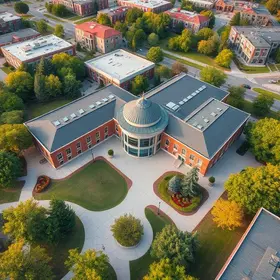
- Baker College is the largest independent college in Michigan with the most focused approach to education and training available. Our mission is to prepare you for meaningful employment. We’re proud to have a 97 percent employment rate among our available graduates. In addition, all our graduates receive Lifetime Employment Assistance—free and forever. Baker’s Clinton Township campus is a place of courtyards and atriums—and advanced facilities equipped with technologies and equipment that perfectly duplicate real-world working environments. It’s all laid out and located to be as convenient as possible for students commuting from Macomb County and beyond. Approximately 5,600 students enjoy a large variety of academic programs, including specialty offerings in elementary and secondary teacher preparation, nursing, radiology, surgical, veterinary and computer technology programs. Students have direct access to our state of the art library facility, the most current nursing, radiology and surgical technology laboratories, as well as a very sophisticated computer technology learning lab environment. You will find Baker College of Clinton Township to be one of the premiere career educational facilities in the nation. Over 400 dedicated faculty and staff take great pride in helping you earn a first rate career education at a very affordable cost.
School Highlights
Baker College of Clinton Township served 3,625 students (47% of students were full-time).
The college's student-teacher ratio of 38:1 was higher than the state community college average of 33:1.
Minority enrollment was 21% of the student body (majority Black), which was less than the state average of 40%.
School Overview
Baker College of Clinton Township
(MI) Community College Avg.
Carnegie Classification
Baccalaureate / Associates Colleges
Associate's Colleges: High Career & Technical-High Traditional
Institution Level
Four or more years
At least 2 but less than 4 years
Institution Control
Private, non-profit
Public
Total Faculty
95 staff
70 staff
Student Body
Total Enrollment
3,625 students
2,473 students
Student-Teacher Ratio
38:1
33:1
# Full-Time Students
1,711 students
889 students
# Part-Time Students
1,914 students
1,584 students
# Enrollment Undergraduate
276 students
403 students
# Full-Time Undergraduate Students
1,706 students
961 students
# Full-Time Graduate Students
5 students
4 students
# Part-Time Undergraduate Students
1,894 students
1,658 students
# Part-Time Graduate Students
20 students
6 students
% Asian
2%
3%
% Hispanic
2%
7%
% Black
16%
16%
% White
79%
60%
% Unknown races
1%
8%
Diversity Score
0.35
0.00
Average Graduate Earnings (10 Years)
$30,600
$28,700
Tuition and Acceptance Rate
Private State Tuition Fees
$8,280
$9,806
% Students Receiving Some Financial Aid
95%
89%
Median Debt for Graduates
$24,000
$12,000
Median Debt for Dropouts
$8,485
$5,500
Source: 2019 (or latest year available) Integrated Postsecondary Education Data System (IPEDS)
Frequently Asked Questions
How much does Baker College of Clinton Township cost?
Baker College of Clinton Township's private state tuition is approximately $8,280.
Recent Articles

As Four-Year Colleges Enter Short-Term Training, Should You Still Choose a Community College?
As universities expand short-term workforce certificates, learn how community colleges compare on cost, flexibility, employer partnerships, and career outcomes.

What New Federal Aid Rules Mean for Short-Term Training Choices
Learn how new federal financial aid rules affect short-term workforce training programs and what prospective community college students should consider before enrolling.

Childcare, Transportation, and Food Support: Services That Drive Community College Completion
Learn how childcare, transportation, food assistance, and other basic needs services help community college students stay enrolled and graduate.